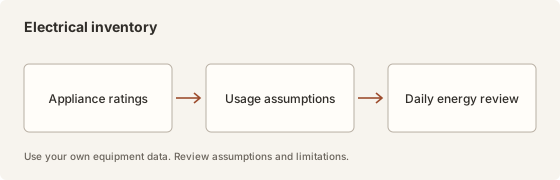
List every electrical load with watts, hours, and duty cycle so battery, solar, and wire choices share one demand picture.
Planning workflow illustration. Confirm your own equipment data and review the result limitations.
Why the inventory comes first
Camper planning fails quietly when each calculator invents its own demand. A single load inventory — name, supply type (AC or DC), watts, quantity, hours per day, and duty cycle — is the shared input for battery autonomy, charging targets, and later wire checks on high-current runs.
Treat preset appliance rows as editable starting points. Labels and manufacturer data sheets override any typical value. If you do not know a wattage, leave the row out or mark it provisional rather than inventing a tidy number.
What to record for each row
For DC loads, use the continuous watts the device draws from the house system. For AC loads behind an inverter, record AC watts and keep inverter efficiency visible when you convert to DC-side energy.
Hours per day describe the period an appliance is available for use. Duty cycle describes how often it actively draws power during that period. Check cycling equipment against measurements or manufacturer information.
Separate simultaneous AC loads from loads that never overlap — surge and continuous inverter checks depend on that flag.
Startup multipliers matter for motors; they do not replace fuse and cable checks on the supply run.
Keep equipment names recognizable when moving from an initial plan to a vehicle project so the inventory remains easy to review.
From inventory to daily energy
Review the daily-energy result alongside the equipment list. Check that AC equipment, cycling loads and occasional appliances are represented accurately before relying on capacity recommendations. No demand does not imply unlimited travel.
Formula assumptions
Watts are continuous operating watts unless a surge multiplier is stated separately.
Duty cycle is a planning fraction of the scheduled hours, not a weather model.
Inverter efficiency is applied to AC rows when projecting DC-side energy.
Worked example
Weekend couple fridge + lights
Add the fridge and check its measured or documented operating power and cycling behaviour.
Add lighting and enter the hours you expect to use it each evening.
Add phone chargers and other small loads that are easy to overlook.
Add occasional AC appliances and confirm their supply type and usage time.
About 629 Wh/day of hypothetical demand before charging. Open the Weekend couple example or the solar & battery calculator with your own edited rows.
Limitations
An inventory is not a wiring diagram, fuse schedule, or installation certificate.
Nameplate data can differ from field measurements; re-check after install.
VanSchema does not invent loads for “typical vans” behind your back.
Manufacturer appliance data sheets (watts, surge, duty)Prefer the specific product sheet for each device; record the sheet name and revision alongside your measurements.
Only if that battery is part of the house electrical plan you are sizing. Starter-only loads belong on a separate inventory so house autonomy is not distorted.
What if two appliances never run together?
Keep both rows for energy, but clear the simultaneous flag on AC loads that are mutually exclusive so inverter continuous checks are not overstated.