Use a real weighbridge or axle scales for baseline mass. Unknown ratings or positions must keep axle verdicts incomplete — never a silent pass.
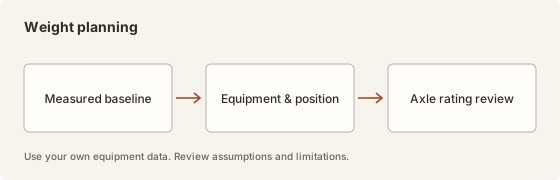
Planning workflow illustration. Confirm your own equipment data and review the result limitations.
Baseline means measured
Enter a measured total mass or measured front and rear axle masses. Do not invent a van model’s dry weight, and do not split an unknown total 50/50 across axles. Until a baseline exists, VanSchema reports needs-input rather than a safe axle verdict.
Review both axles after adding equipment
Equipment location affects the front and rear axles differently. Record wheelbase and load positions using a consistent front-axle reference, then review both axle results against the vehicle’s ratings. Reweigh the finished vehicle; a planning estimate does not replace measured axle loads.
Water and “already included” flags
Tank dry mass and water contents are separate. Record the water and equipment present at baseline weighing, then state the planned travel contents explicitly. Mark equipment already included in the baseline so the scenario represents what you intend to add.
Formula assumptions
Payload math is a static two-axle model on level ground.
Weight ranges produce low/high scenarios — never a silent midpoint presented as exact.
Unknown mass, position, GVWR, or axle rating blocks a complete pass.
Worked example
100 kg addition at 3 m on a 4 m wheelbase
Record front and rear baseline measurements from the same weighing session.
Add the equipment mass and its intended position relative to the front axle.
Enter permitted gross and axle ratings, then inspect each result and any missing-input notices.
Use the payload & axle load calculator with your own measurements. Public examples leave the baseline unset and cannot establish whether your vehicle is within its ratings.
Limitations
Not a dynamic rollover, braking, or tyre-load certification.
Overhang mixtures may be marked incomplete rather than claiming extrema.
Legal plate limits and regional definitions of GVWR/GAWR override any planning tool.
Because their measured baseline is intentionally null. Copying an example into your project still requires your own weighbridge numbers.
Can I enter only one axle reading?
Axle mode needs both front and rear measured values that sum to a positive mass. Use total mode if you only have a single scale reading for the whole vehicle.