Battery sizing from usable energy, not nameplate Ah alone
Convert daily demand and depth-of-discharge into usable watt-hours, then compare planned banks without pretending Ah is a universal unit across voltages.
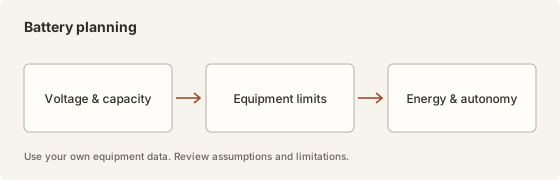
Planning workflow illustration. Confirm your own equipment data and review the result limitations.
Compare usable energy, not Ah alone
Record the battery’s nominal voltage, capacity and permitted usable fraction from its documentation. Review the usable-energy and autonomy results together, and compare alternative capacities against the same usage assumptions.
Ah figures are not comparable across voltages. Keep nominal voltage visible when comparing packs, and use the tool’s energy result rather than ranking batteries by Ah alone.
DoD is a planning choice bounded by the battery and BMS
Battery limits depend on the manufacturer’s voltage, temperature and BMS specifications rather than a single universal DoD percentage. Your allowed DoD must stay inside the battery and BMS limits from the product documentation. VanSchema treats DoD as an explicit planning input — it does not certify a chemistry.
Recommendations vs installed specs
Demand-based battery recommendations are sizing suggestions. Installed voltage and Ah come from the specification item you link in a project. Changing Ah updates usable energy and autonomy; dry mass and price stay exactly as you entered them — they are never auto-scaled.
Formula assumptions
Permitted usable capacity must follow the battery and BMS documentation.
Autonomy depends on the entered usage and available capacity; no-demand plans do not imply unlimited travel.
System voltage comes from the linked battery specification in a project.
Worked example
24 V bank from 200 Ah to 400 Ah
Enter a 24 V, 200 Ah planning bank and the usable fraction permitted for your equipment.
Enter the daily loads you expect to use and review the autonomy result.
Compare a 400 Ah alternative while keeping the usage assumptions unchanged.
Leave price and dry mass fields untouched — re-estimate those separately.
Try the Remote work example or the solar & battery calculator, then replace its starting values with your own equipment data.
Limitations
The daily-energy estimate here does not model the timing of loads and charging; use the separate timeline tool when available.
Parallel/series string design, BMS programming, and fusing need installer review.
Cold-weather capacity loss is not auto-applied; adjust DoD or Ah using manufacturer data.
Choosing an equipment role does not establish its installed specification. Enter voltage and capacity from the actual equipment documentation before reviewing its results.
Is 90% DoD safe for every LiFePO4 pack?
No. It is only a planning fraction. Follow the pack and BMS limits for low-voltage cutoff, temperature, and continuous current.